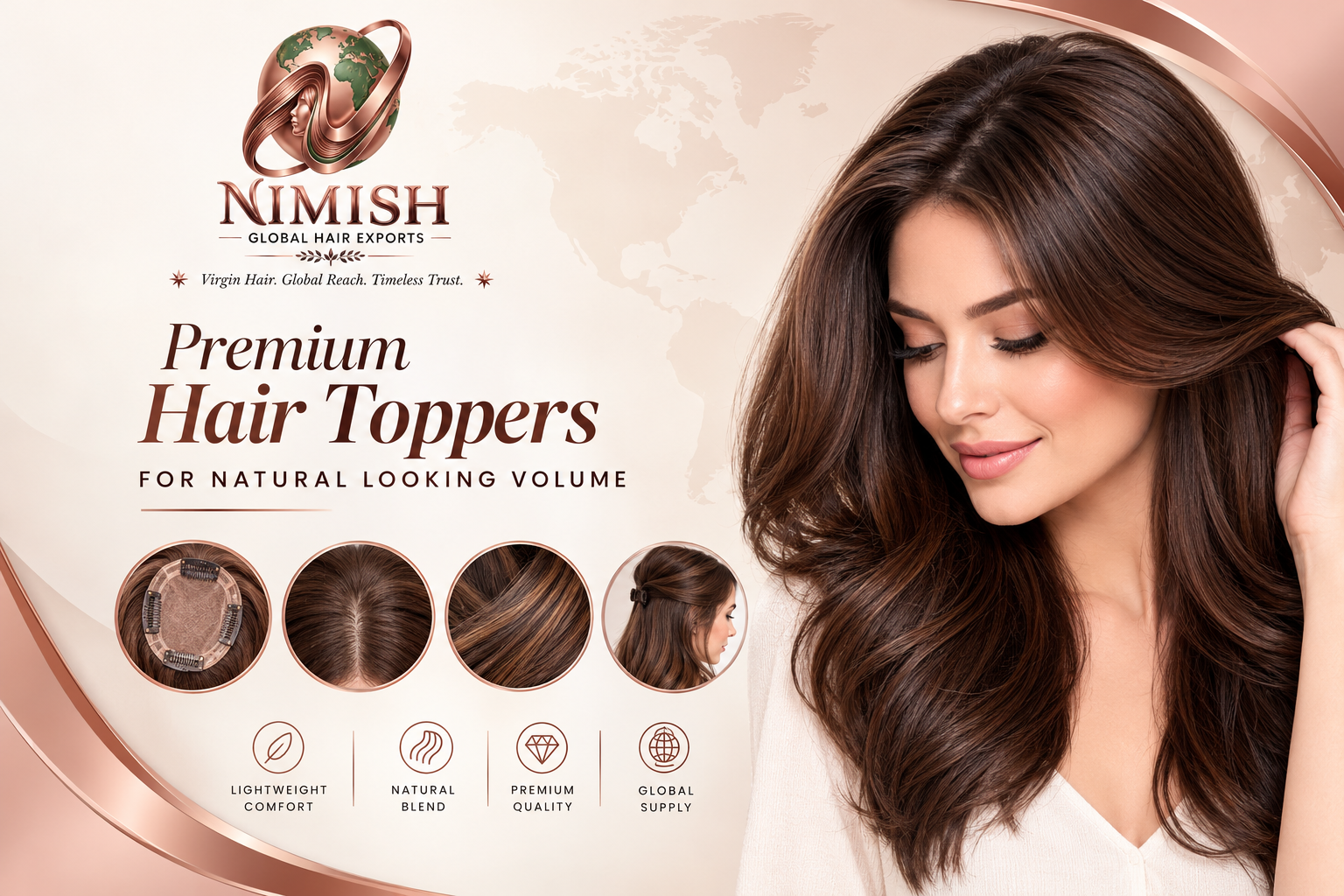
Best Hair Toppers for Women: How to Choose and Blend for Thinning Hair
Best Hair Toppers for Women provide a multitude of styles for thinning hair. These are perfect for creating a wider part, adding body to a flat surface, and filling in a bare crown. For women suffering from hair loss in a few isolated areas, a topper may be a better option than a full wig to blend in with natural hair.
A topper that is right for one woman may not be for another. For thinning hair to best utilize a hair topper there are a variety of factors to take into consideration such as how much coverage is required, the texture and color of the existing hair, and how the topper will be styled in day to day life.
In the USA and South Africa, understanding these principles can aid in the selection process. At Nimish Global Hair Exports, we know that the best hair products provide a balance of natural appearance, construction and the flexibility to style in a multitude of ways.
Whether shopping for personal use or for a hair product business, having this knowledge can help you make better purchase decisions.
What is a Hair Topper?
A Hair Toppers is a partial hairpiece worn to provide added volume and coverage for a portion of the scalp. Full wigs cover most if not all of the hair, whereas a hair topper covers a smaller area and is worn over the crown, top of the head, parting, etc.
Base sizes, attachment systems, lengths, colours, and hair types all determine the variety of hair toppers. Some hair toppers use synthetic fibers while others may use human hair.
Hair toppers are generally useful to women who want to:
- Add volume to the crown.
- Make the widening part look more full.
- Help cover mild to moderate thinning in a specific area.
- Help blend longer and thicker hair with shorter and thinner hair.
- Change their hairstyle without wearing a full wig.
The best hair topper option is determined by the pattern of thinning and how much healthy hair is available for attachment.
Types of Hair Toppers for Women
In order to know which hair topper is best, it is important to understand what types of toppers are available.
1. Human Hair Toppers
Toppers made from human hair can look natural if the texture and density are correct. These toppers may be more natural looking and can hold a curl or be straightened depending on how they are constructed. Always refer to the manufacturer’s guidelines to determine how to care for the topper.
Best for: Women wanting the most natural hair topper that can be styled like natural hair.
What to consider: Human hair toppers are more expensive than synthetic toppers and can require more maintenance.
2. Synthetic Hair Toppers
Synthetic toppers are ready to be worn and may require little styling.
These toppers are able to hold their shape and hold a curl if the fibers are made with a special material. Special care instructions should always be referred to if using heat on a synthetic topper.
Best for: Women wanting the least maintenance and less natural appearance of a hair topper.
What to consider: Can’t be heat styled.
Some synthetic fibers can take heat, but others can’t take the heat from your hot tools. Check the product details before applying heat.
Best For: Women who like a pre-styled option and an easy to follow care routine.
What to Consider: The fibers may behave differently from human hair when subjected to various factors such as washing, friction and prolonged use.
3. Monofilament Hair Toppers
A fine mesh material supports individual hairs in a monofilament base. This design may give the appearance of hairs emerging from the scalp, including in the parting.
Best Result is determined by the craftsmanship, base, and color of the hairs and individual preferences.
Best For: Women who wish to have a base and a parting that is more realistic and less noticeable.
4. Lace-Base Hair Toppers
Lace base toppers offer a lightweight, flexible base that can give a natural edge when correctly matched to the scalp.
Comfort and wearability depend on the construction and individual sensitivity.
Best For: Women who prefer a natural edge, but may not be as lightweight as some bases.
5. Silk-Base Hair Toppers
A layered design of a silk base conceals the attachment points to give the appearance of hairs growing from the scalp.
A silk base offers a natural parting and fuller coverage, especially at the top of the head.
Best For: Women who prefer a more natural parting.
How to Choose the Right Best Hair Toppers for Women With Thinning Hair
Toppers should complement your existing hair and not simply add as much hair as possible. Keep the following in mind before making a purchase.
1. Determine the Area Requiring Coverage
Decide on the area you wish to have additional coverage.
Crown Thinning: Look for a topper that covers the upper back of the scalp.
Part Widening: Look for a parting or crown topper to cover the affected area.
Thinning at the Top: Look for a topper that covers a larger area.
Thinning Near Front Hairline: Look for a topper that covers that area. Determine if the method of attachment used is suitable to your existing hair.
If thinning is very extensive or if the scalp is very sensitive, a clip-in topper may not be appropriate. A hairpiece specialist may be able to assess other means of attachment.
2. Determine the Base Size Accurately
The base of a topper should adequately cover the area requiring coverage and should not be very large.
For a base with adequate coverage, measure the length and width of the area requiring coverage and follow the instructions of the supplier.
A base that is too small may not cover the thinning area. A base that is too large may be very difficult to attach and may not blend with existing hair.
Always consult a professional fitter for a custom or high value topper.
Match the Hair Colour
One of the most essential steps of the hair topper process is to colour match.
When looking at the colour of your hair topper, try to do so in natural lighting, as opposed to relying on photographic evidence.
When considering the colour of your hair topper, think about:
- Roots vs. ends
- Natural colour variations
- Undertones
- If your hair is multi-tonal
Someone who may have naturally darker, brown root hair and caramel ends may require a topper that begins to blend through the length of the hair, rather than having a flat, solid, uniform colour.
When purchasing a hair topper online, make sure to ask for clear photographs if none are supplied, ask for colour codes if they are supplied, and ask for a sample if they are offered.
Choose Appropriate Hair Length
Toppers that extend beyond the natural length of your hair may be difficult to blend and style.
Shorter toppers may be more appropriate for long bobs, while longer toppers may be more appropriate for hair that falls below the shoulder.
The goal should be for the hair topper to blend when your hair is styled as it normally is.
Select Appropriate Density
Higher densities may create a better look and feel of your hair topper, however, if the density of your hair topper is too much in comparison to your natural hair, it may create an obvious transition.
Your natural hair volume, age, preferred hairstyle, and coverage needs will also impact your choice.
6. Consider the Attachment Method
Hair toppers can be attached using different methods including clips, combs, and/or tape, etc.
Clip-ins are the most common method, but they put tension on already weakened or thinning hair, causing it to break off and/or result in traction alopecia. This is especially harmful for already fragile hair on the scalp.
Depending on your level of scalp sensitivity and the amount of hair on the attachment area, discuss other options with your hairpiece specialist.
7. Decide on Human or Synthetic Hair Based on your Availability
Based on your commitment level, decide on human or synthetic hair.
With human hair, you can style it as you like, but it takes time to maintain and care for it. Synthetic hair, on the other hand, doesn't require a lot of maintenance, but is limited in styling.
Styling is totally up to you, depending on what climate and lifestyle you're looking to fit it into.
How to Blend a Hair Topper with Natural Hair
There are several ways to attach a hair topper, but only one really helps camouflage it- blending. To help your topper seamlessly integrate with the rest of your hair, follow these steps:
1. Prepare Your Natural Hair
Work with the manufacturer's instructions to prep your natural hair, and get it in the proper condition for attaching a hair topper.
This step describes the method of sectioning the hair and positioning the topper.
You can lightly detangle your hair to define the area where the topper will be placed. With delicate, thinning hair, do not pull too tightly on the strands as they may break or fall out.
Apply styling products to the topper as you normally would, if necessary, to avoid unsightly buildup.
2.) Position the Topper Correctly
You must position the topper from all angles. The front edge should be in relation to your part or hairline (if the hairline is receding).
If the topper is too tight, it can pull on your natural hair and cause additional thinning and breakage.
3.) Blend the Parting
Unless the parting is to the side, position the part in a way that best suits your natural part.
Depending on the base and the color of the scalp, a more realistic parting can be achieved with the help of powders or products, however be sure to check with the manufacturer as some may not be safe to use on the base.
4.) Blend the Texture
How the topper moves in relation to the rest of your hair is very important. For example, if you have naturally wavy hair, a straight topper may not be a good choice.
If your natural hair is tightly curly and your topper is straight, it may also be obvious. Changing the texture slightly or switching to a more realistic curl pattern may be a good choice. Always check with your manufacturer or hairstylist before using heat on a topper.
5: Create a Smooth Line
If you use a professional stylist who is trained in the use of hairpieces, they may be able to help blend the topper and your natural hair to create a smoother, more seamless line.
Light layering or face framing pieces may also help.
Cutting a topper may damage it beyond repair. Only cut a topper if you are skilled at doing so, and only cut it if the manufacturer states the hairpiece is intended to be cut.
Look at the Results in Different Lighting
Daylight and artificial lighting as well as photographs may show different results.
Examine the parting, attachment points, the color blend and the overall line.
Gently shake your head to make sure the topper stays in place.
If you see clips or the base of the topper, adjust it rather than pulling on the topper with a lot of force.
Caring for Hair Toppers in the USA and South Africa
How you take care of your topper will depend on your location and the activities you do on a given day. Choose a care method that matches your environment and the product you are using.
Washing and Conditioning
Wash and condition hair toppers according to manufacturer's instructions.
Synthetic toppers may require special conditioner and shampoo made for synthetic fibers, while human hair toppers may require special shampoo and conditioner made for human hair.
Do not rough the hairpiece up or use excessive heat when drying. Allow the topper to dry before removing it and make sure to remove any tangles before washing.
Managing Humidity
Humidity may cause your hair to swell and/or frizz. You may use a light hold gel or a setting spray to help achieve a smoother style.
Choose the right texture for your natural hair and your local climate, and store the topper in a clean, dry place away from direct sunlight, hot cars or trunks, etc.
Protecting the Base
The base of the topper can be quite delicate while the hair itself can be strong.
Inspect clips and attachment points for damage regularly and be gentle when handling lace and fine mesh, as well as other fragile materials.
Reducing Friction and Tangles
Friction can cause the hair to tangle, and this is worsened by scarves and other bedding, as well as frequent handling. Use a pin or wide-tooth comb to detangle and work from the ends up.
When not in use, store the topper in a shape-retaining manner.
Hair Toppers for Personal and Wholesale Use
Hair toppers are used by individuals and by businesses including salons, wig retailers and hair replacement specialists and online beauty product retailers.
Hair toppers and hair extensions serve different purposes. Customers should ensure suppliers offer the right product category.
What Wholesale Buyers Should Consider
When considering a bulk order, examine the supplier as well as the product.
Product Consistency: Check for consistent color options, base construction, density, length, and texture of hair across samples and batches produced.
Clear specifications: Ask for clarity on whether the hair is human or synthetic, the bases, the attachment system, available sizes, and styling limitations.
Quality control: Inspect products for shedding, tangling, and construction defects and color variation.
Order terms: What are the MOQs? Lead time? Terms? Packaging? Policies on damaged or incorrect goods?
Shipping and import requirements: The USA and South Africa customers must confirm shipping costs, customs duties, import requirements and estimated times before placing an order.
Communication and Support: A supplier that clearly answers product questions is a great start for product support.
The importance of product knowledge for retailers
When it comes to sellable toppers, customers require plenty of assistance. A knowledgeable retailer on bases and density can explain to the customer the advantages of a particular product. Based on the consumer’s concern, e.g. thinning crown vs. widening part, the retailer can recommend a suitable topper, and give the consumer a few options rather than pushing the same topper on them.
Common Problems With Choosing a Hair Topper
It can be very disappointing to receive a topper you've ordered and find that it is unsuitable. Poor quality toppers can look and feel unnatural.
Choosing Too Much Density
Too much density can create an unnatural look with visible contrast against your existing hair. Choose a density that complements your hair to create a natural look.
Misjudging Colors
Hair toppers that match your ends may have a different color where they meet the root or parting. Highlights can also contribute to color differences. Consider all of these when deciding on a color for your topper.
Using Clips on Thinning Hair
Tugging on thinning hair with clips can increase the rate of breakage. See a professional for advice about other methods of attachment.
Purchasing the Wrong Base Size
Bases that are too small to cover thinning areas can result in obvious patches. Thoroughly measure your thinning area before purchasing a toper.
Neglecting Maintenance
Over time, a topper can become matted and accumulate oils and dirt from hair. Check the attachment to your topper and follow the included instructions for care.
Not Budgeting For Haircuts and Trims
Many toppers require styling and trimming to achieve a natural look. When researching toppers, you should take into account the cost of getting a haircut and styling your hair.